Key Takeaways
- UV400 sunglasses block invisible ultraviolet light, while polarized sunglasses use a filter that removes reflected glare bouncing off water, wet roads, and snow.
- UV400 is the pair you should never go without, since it lowers your long-term risk of cataracts and eye growths, costs little, and works on overcast days, though it does nothing for glare.
- Polarized sunglasses sharpen contrast, cut eye fatigue on long drives, and let anglers see beneath the surface, though they cost more and can black out dashboards, phones, and GPS screens.
- Polarization and UV400 aren't interchangeable, so a polarized pair with no UV400 rating can still let ultraviolet light reach your eyes.
- At All Star Shady, we add UV400 protection to every polarized pair we sell, across aviators, wayfarers, cat-eye, oversized, and sports wraps like the APEXUP, with fast shipping across the United States.
Polarized vs UV400 Sunglasses: What's the Main Difference?
UV400 is a protection rating, while polarized is a lens feature. UV400 lenses block ultraviolet light up to 400 nanometers, covering UVA and UVB rays. Polarized lenses filter horizontally oriented light waves, which cause reflected glare off water, roads, and snow.
Think of it this way. UV400 is your sunscreen, and polarization is your contrast filter. One guards your eye health over decades, and the other makes the next hour outdoors more comfortable.
UV400 belongs in every pair you own, since UV damage accumulates invisibly and no tint or price tag proves protection is there. Polarization is worth paying for when glare is part of your day, though it can dim LCD screens and adds nothing to your UV defense.
You don’t have to choose between the two. At All Star Shady, we stock polarized lenses with UV400, so you get both without paying premium prices.
All Star Shady: Celebrity-Inspired Sunglasses, Without the Celebrity Price Tag!Polarized UV400 Eyewear | Based in Portland, Shipping Across the USA
✓ UV400 protection and glare-reducing polarized lenses Your eyes deserve protection. Your style deserves the spotlight. |

How Do UV400 and Polarized Lenses Work?
How Do UV400 Sunglasses Work?
The "400" in UV400 refers to 400 nanometers, the upper boundary of the ultraviolet light spectrum. UV400-rated lenses block 99 to 100% of both UVA rays (315 to 400 nm) and UVB rays (280 to 315 nm).
UV protection in a lens comes from the lens material itself or from a UV-blocking coating applied to the surface. Polycarbonate lenses, for example, naturally block UV light without any additional coating, because the material absorbs it at a molecular level.
CR-39 plastic lenses don’t block the full UV range on their own, so they need an added coating to reach 400 nm.

Dark lenses look protective, but only a UV400 rating tells you they block ultraviolet light.
How Do Polarized Lenses Work?
Polarized lenses work through a special filter built into the lens that blocks a specific light orientation. When sunlight hits a flat horizontal surface, such as water, a wet road, a car hood, or a snowfield, it reflects back as a concentrated horizontal light wave. That is glare.
The polarized filter is oriented vertically, blocking those horizontal waves before they reach your eye. The difference is easy to notice. Colors look more vivid, contrast sharpens, and your eyes tire less on long days outdoors.
Polarized vs UV400: Head-to-Head Differences
Eye Health Protection
UV400 wins this category. Long-term UV exposure is linked to cataracts and eye growths, including cancer. The American Academy of Ophthalmology recommends UV-blocking sunglasses any time you’re outdoors, including on cloudy days, since UV rays can pass through clouds.
Polarization offers no UV protection on its own. It manages visible light only.
Glare & Visual Comfort
Polarized lenses dominate in glare reduction. If you spend hours on the water, behind the wheel, or on a ski slope, the difference in visual comfort between polarized and non-polarized lenses is not subtle. It can reduce squinting and eye strain over a long day outdoors.
Lens Darkness & Tint
Tint, rather than UV400 or polarization, is what mainly sets how dark a lens looks.
A UV400 lens can be nearly clear or very dark. A polarized lens can’t be fully clear, since the filter itself blocks some light, but it still comes in options from light amber to dark gray, copper, or mirrored finishes.
Tint color affects contrast and color perception. Gray tints preserve natural color, while amber and copper tints boost contrast in low light or overcast conditions. Neither tint color nor darkness indicates UV400 or polarization.
Pros & Cons of UV400 Lenses
Pros of UV400 Lenses
- Blocks 99 to 100% of both UVA and UVB radiation up to 400 nanometers
- Available at every price point, from budget sport frames to high-end optical, so it is not a premium-only feature
- Works in all conditions, including overcast days when UV still passes through cloud cover
- Compatible with any lens tint, color, or darkness level
- Reduces your long-term risk of cataracts and growths on the eye, and guards against photokeratitis from intense UV exposure
Cons of UV400 Lenses
- Does nothing for glare, so bright days near water, snow, or wet roads will still leave you squinting
- Impossible to verify yourself, since UV blocking is invisible and you have to trust the labeling, which is why the seller's credibility counts
Pros & Cons of Polarized Lenses
Pros of Polarized Lenses
- Cuts reflected glare from water, roads, snow, and sand
- Enhances contrast and color depth, so your surroundings look sharper and more vivid
- Reduces eye fatigue on long days outdoors, behind the wheel, or on the water
- Lets anglers see beneath the surface by removing the reflection on top of it
- Especially effective for skiing, fishing, boating, cycling, and long-distance driving
- Easy to verify at home by tilting the lens in front of a phone or computer screen, since a polarized lens darkens the screen at certain angles
Cons of Polarized Lenses
- Interferes with LCD and digital screens, so dashboards, GPS units, phones, and ATM displays can wash out or black out at certain angles
- A genuine problem for pilots, heavy equipment operators, and anyone who needs screen visibility outdoors
- Usually costs more than non-polarized UV400 at the same quality tier
- Provides no UV protection on its own, so a polarized lens without a UV400 rating leaves your eyes without reliable UV protection
Which Lens Should You Buy?
Best for Everyday Wear
For errands, commuting, and casual outdoor time, UV400 is the minimum. A well-made lens in a neutral gray or brown tint handles most daily conditions comfortably. Polarization is a welcome addition, though less critical when you are not spending long stretches in high glare.
Best for Driving
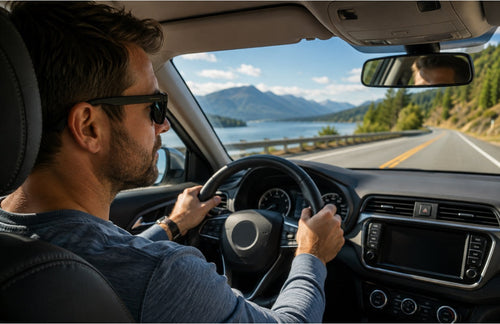
Driving makes one of the strongest cases for polarized UV400 lenses. Wet pavement and low morning or evening sun produce exactly the horizontal glare that polarization cuts, and a dark gray polarized lens is the go-to choice.
All Star Shady's Men’s Polarized Aviators use polycarbonate lenses that hold their UV block in the material itself, on a metal frame light enough for long stretches behind the wheel.
Best for Water, Snow, & High-Glare Sports
Fishing, skiing, snowboarding, kayaking, and surfing all expose you to surfaces that throw light back at you.
Snow reflects far more UV than grass or soil, which can sharply raise your exposure on the slopes, and sand and sea foam reflect some UV as well. Water reflects little UV but plenty of visible glare, so both features earn their place here.
All Star Shady's APEXUP polarized sports sunglasses handle these conditions with anti-fog and hydrophobic coatings on a TR90 frame that flexes instead of snapping. For women who fish, the Women's Polarized Fishing Sunglasses offer a slip-free fit that stays put when you lean over the side.

All Star Shady's APEXUP unisex polarized sports sunglasses come with UV400 anti-fog hydrophobic lenses for all-day outdoor comfort.
Why the Best Option Is Usually Both
A quality polarized lens from a reputable brand will almost always carry a UV400 rating. This combination covers both needs: full-spectrum UV protection that guards your eye health long term, plus polarization that makes time in glare sharper, more comfortable, and less tiring.
The exception is anyone who relies on LCD screens outdoors, such as pilots or heavy equipment operators, who may be better served by a non-polarized UV400 pair.
UV400 vs Polarized Sunglasses: Comparison Table
|
Feature |
UV400 |
Polarized |
|
What it does |
Blocks invisible ultraviolet radiation |
Filters horizontally reflected visible light |
|
What it protects against |
Long-term UV damage to the eye |
Glare from water, roads, snow, and sand |
|
Effect on vision |
None, since UV is invisible |
Sharper contrast and richer color |
|
Affects lens darkness |
No |
Slightly, so a polarized lens can’t be fully clear |
|
Known drawbacks |
Does nothing for glare |
Can black out LCD screens at certain angles |
|
Best for |
Every pair of sunglasses you own |
Driving, fishing, boating, cycling, and snow sports |
Get Polarized UV400 Sunglasses at All Star Shady

At All Star Shady, we stock polarized lenses with UV400 protection, so you get glare control and eye protection in the same pair.
The key distinction is that UV400 protects your eyes, while polarization protects your comfort. One is a health requirement in every pair you own, and the other is an upgrade that pays off the moment you step into glare.
At All Star Shady, our polarized sunglasses come with UV400 protection as standard, from aviators for the morning commute to the APEXUP sports wrap for days on the water. Our frames are light enough for all-day wear and ship fast across the United States. Shop the full sunglasses range and get a pair that protects your eyes while cutting glare.
Frequently Asked Questions (FAQs)
Are polarized sunglasses better for driving?
Yes, polarized lenses are a clear upgrade for driving, especially on wet roads or in low morning and evening sun, because they cut the horizontal glare bouncing off pavement. A dark gray polarized lens with UV400 is the best pick, since gray keeps colors accurate and traffic signals easy to read. Some dashboard and GPS screens may look dim at certain angles, so check yours before a long drive.
Do more expensive sunglasses always have UV400?
No, price is not a reliable guide to UV protection. Some designer frames prioritize looks over optics, while plenty of affordable sport sunglasses carry full UV400, because polycarbonate blocks UV cheaply. Look for the explicit label, no matter what you pay.
Can you add UV400 coating to any sunglasses?
Sometimes, since optical labs can apply UV coatings to certain materials, including CR-39 plastic, though not every lens accepts them well. The result rarely matches factory protection, so buying a pair with UV400 already built into the lens is the safer route.
Are UV400 sunglasses safe for looking at the sun?
No, UV400 lenses block ultraviolet radiation, not the concentrated visible and infrared light that damages your retina when you stare directly at the sun. Only eclipse glasses and handheld solar viewers certified to ISO 12312-2 are made for looking at the sun.
Can sunglasses be both UV400 and polarized?
Yes, and it is a common pairing, since the two features work at different layers of the lens without interfering with each other. Every polarized pair from All Star Shady includes UV400 protection as standard, whether you want a classic frame for everyday wear or a sports wrap for days on the water.
*Disclaimer: Product availability, pricing, and styles are subject to change without notice and may vary by design, size, and stock levels. Always confirm current details directly on the retailer's website before purchasing. For more information, visit All Star Shady.